Wednesday, April 25, 2007

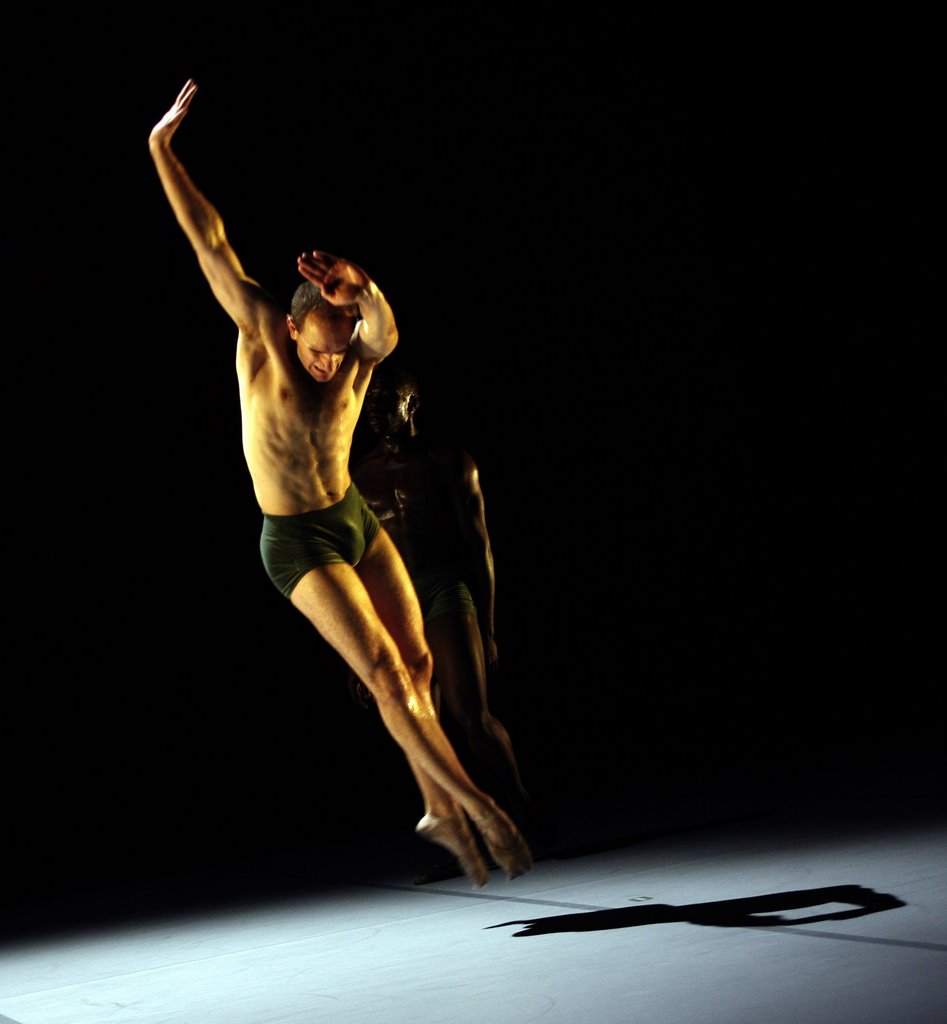
Lines Ballet in collaboration with the Shaolin Monks, 4/20/2007

Lines Ballet in collaboration with the Shaolin Monks
April 20, 2007
Yerba Buena Center for the Arts

Most likely, when you think of ballet, you don’t automatically think kung fu. Or monks. Or young boys performing front headsprings (yes, head, not hand) across a stage. But thanks to Alonzo King’s creative wit, that’s exactly what we got with Lines Ballet’s collaboration with San Francisco’s localized Shaolin Monks. This evening (rumored to be titled “Long River High Sky” yet not listed as such anywhere in the materials) combined King’s distinctive contemporary choreography with the Monks’ kung fu, tai chi, gymnastics, and overall calming presence, and what began as a ballet vs. monk dichotomy ended with a common understanding that both performance styles and beliefs held beauty and strength in high regards.

Surprisingly, a third “performance style” emerged quietly yet powerfully through the work: that of the musicians. Hong Wang, Wanpeng Guo, and Shenshen Zhang of Melody of China harmoniously accompanied the performers using 15 different instruments (banhu, dizi, and concert sheng to name a few). At times, I found my mind drifting off listening to the music, harmonious and serene at times and quickly beating at others.

While the program spanned a lot of ground throughout the two halves and its 29 sections, the fusion we all expected never quite took flight. Many times, the monks looked like props to the Lines dancers and vice versa, and the two forms never quite developed a visually pleasing balance. I expected something more than the mishmash of form against form: a newly codified movement style or editing to create more “common ground,” perhaps. But even with these issues, the program envelopes your senses and mind with images of what might be possible with a little bit of artistic effort and imagination (except that of monks in arabesque).

Saturday, March 24, 2007

SF Ballet, Program 5, 3/23/2007


Thirstquenchingly good

San Francisco Ballet
Program 5
March 23, 2007, 8PM

San Francisco Ballet’s season is quickly cresting past the halfway mark, and Program 5 swelled this Friday evening with four contemporary yet differing works.

The evening’s highlight proved to be the debut of Christopher Wheeldon’s “Carousel (A Dance)” to the music of Rodgers and Hammerstein’s musical of the same name. Sarah Van Patten and Pierre-François Vilanoba, as the young lovers, transformed the stage from sheer performance into an alluring story, and a well-danced one at that. Wheeldon, breaking out of his Balanchine-esque ways, choreographed an enjoyable vision to watch, and as the couple’s relationship grows, you almost want to giggle giddily along with Van Patten as she realizes she’s in love. The orchestra, conducted by Martin West, swayed confidently through the score, and the corps’ human carousel at the end (oh, what a spectacle!) adds an extra “oomph” element to “Carousel,” all the more reason to relish and bathe in the sweet moment.

Mark Morris’ “Pacific” glided to and fro with a freshness matched only by Lever 2000. Bodies leaped and arched in succession, reminiscent of the ocean on a clear day. Tina LeBlanc and Nicolas Blanc (filling in for an injured Gennadi Nedvigin) displayed warmth and intimacy as the red couple; him lifting her as though she were a continuation of his arms, and she graciously reaching to him as she twisted into a stretched out attitude. Elana Altman, as one of the four “green women,” provided grandeur and tranquility as she jetéd and swirled about.

Not to be outdone, Helgi Tommason’s “The Fifth Season,” to music by Karl Jenkins, returned to the stage with a punch. Katita Waldo looked in fine form with her long limbs jutting forwards and a cool demeanor as she tapped her foot, and Gonzalo Garcia matched her well in both presence and style. Van Patten and Vilanoba moved their way across the stage with a ballet-based tango that would put “Dancing with the Stars” to shame. Yuan Yuan Tan and Tiit Helimets, as the third couple, connected softly throughout Sandra Woodall’s art gallery-like space. The corps, though, was poorly costumed and unfortunately served no purpose other than to add eight more bodies to the already well-crafted space.

Rushing in like high tide, Jerome Robbins' “Fancy Free” progressed quickly and assuredly. The three giddy sailors (Gonzalo Garcia, Garrett Anderson, and Pascal Molat) had only two things on their mind: girls and girls. With all their might, they competed in their own little dance-off: a battle of jumping, sliding, time-stepping, and posing all for the chance to get a girl. Erin McNulty, clutching a scarlet purse, had great attitude (even with an unfortunate stumble early on), and clad in violet, Vanessa Zahorian daintily humored the men in white. And yet just when the guys think their shore leave has been a bust, in strolled Elana Altman to boost their egos once more.

Cool and hydrating, Program 5 quenches your thirst for edge, variety, and solid dancing. Let’s hope the rest of the season lives up the bill.

Sarah Van Patten and Pierre-François Vilanoba in Wheeldon's Carousel.
© Erik Tomasson

Wednesday, March 14, 2007

SF Ballet, Program 4, 3/13/2007


Just copy and paste
San Francisco Ballet
Program 4
Tuesday, March 13, 2007

The city’s ballet aficionados were out in full force Tuesday night for the premiere of San Francisco Ballet’s Program 4, a mixed, and contemporary, bill chockfull of imagery and appeal.


The hit of the night proved to be the US premiere of Wayne McGregor’s “Eden/Eden,” which was originally choreographed for Stuttgart Ballet. A beautifully disturbing look at human cloning, nine dancers, dressed in striking attire by Ursula Bombshell and led by the stunning Muriel Maffre, explore the world of carbon copies and the slight nuances that make us human. Drawing on aspects of Adam and Eve (here, Eve came first!), the dancers delve into the deep issues of immortality, choice, and individuality. Dana Genshaft showed amazing flexibility and line during her sections with Pascal Molat, and Hayley Farr stretched and cavorted like a pixie. In fact, the entire cast astonished me with their ability to move very rhythmically in a very non-traditional way, and if I hadn’t known better, I would have thought we were in Germany. Charles Balfour’s stark lighting initially covered the stage with a silvery-white newness a baby might experience in its early stages, and later the lights transcended to a rich, dewy orange, similar to a sunny evening at Baker Beach. Minimalist Steve Reich’s rich and ear thrilling score combines text, vocals, techno, and classical music in a way that made me bop along in my seat while wishing I could grand battement up the aisle, down Van Ness, and towards the bus stop. Intellectual yet intricately choreographed, “Eden/Eden” builds to a satisfying yet still disturbing climax, which had many jumping to their feet in applause at the end.


The encore of Paul Taylor’s “Spring Rounds,” with music by Richard Strauss, was led by Vanessa Zahorian and Garrett Anderson, who both danced with ease and a genuine nature-- there’s nothing forced here. Both looked natural, and very much like a Taylor dancer (only better) with the tuck of a pelvis here, a curve of the arm there. Their pas de deux spoke volumes, even though it evoked a quiet time of growth between two people; these are dancers who can do more than just ballet. Sprouting up and dancing fervently like spring could end tomorrow, the lime green-clad corps of 12 dancers clad flew from corner to corner and around in circles, whipping out tuck jumps and sauté attitudes front and back, and while I like my weather a little on the cool side, “Spring Rounds” made me glad spring is truly here.


Helgi Tomasson’s “Chi-Lin,” which debuted in 2002, returned to the Opera House, yet seemed out of place compared to the other two works. Tomasson collaborated with Bright Sheng, a past MacArthur Award winner, on the score and concept, but while there’s plenty of glitz and tricks, the superficial “Chi-Lin” seems to be lacking in substance, development, and musicality. Yuan Yuan Tan seemed warmer and more sensual compared to her “Chi-Lin” of five years ago, and Tiit Helimets proved slow and steady can be beautiful as the Tortoise. But Hansuke Yamamoto’s Phoenix didn’t quite have the spring of Parrish Maynard’s debut, and Pierre-François Vilanoba, bless his heart in those golden hot pants and a wig full of dreds, did the best he could with the limited movement vocabulary. The men’s and women’s corps, while mostly there for show, seemed off or out of sync at times, but they also proved the point that sometimes less is more. Too much can be a distraction, and we don’t need a ballet that has everything but the kitchen sink in it unless everything is just amazingly structured, developed, and presented. Then please, go right ahead.


Program 4, without a tutu in sight, aims to please the contemporary ballet-goer, and “Eden/Eden” is not to be missed. If only all dance programs were this good.


Dana Genshaft and Pascal Molat in McGregor's Eden/Eden.
© Erik Tomasson

Monday, February 26, 2007

SF Ballet, The Sleeping Beauty, 2/24/2007

Smells like teen spirit
San Francisco Ballet’s “The Sleeping Beauty”
Saturday, February 24, 2006, 8PM


As a teen, the first full-length non-Balanchine story ballet I saw was The Royal Ballet’s “The Sleeping Beauty.” One of my fondest memories of this was the awe factor: the first time the fairies entered, Aurora balancing during the Rose Adagio, and later the celebratory wedding scene. Last year’s rendition by the Kirov Ballet didn’t quite hold up to my adolescent memories, but this weekend, San Francisco Ballet stood up to the challenge with its own version.

Choreographed by Artistic Director Helgi Tomasson (after Marius Petipa, of course) in 1990, this Sleeping Beauty paints more than just a pretty picture. Sure, there are attractive sets, happy corps de ballet dancers, lavish yet understated costumes and wigs, and the well-known story, but what’s more, there are also dancers with determination and spirit. Yuan Yuan Tan, Saturday’s Aurora, showed us that beauty is more than skin deep. While not completely believable as a genuine, sprightly 16 year old, Tan performed with grit and flow, with jaw dropping balances in attitude (I think I counted at least 5 seconds in there somewhere. Thank goodness for the evening’s conductor, Martin West, and his baton!) during the Rose Adagio. Later on, when she came “out of retirement” at the ripe ol’ age of 116, Tan seemed more relaxed and refined, allowing her upper body to flow more and adding a peaceful smile to her face. Maybe the 100-year nap was a good thing. Or perhaps this was her reaction to her newfound love for the ever-able Prince Desiré, portrayed by Tiit Helimets, who partnered her soundly and effortlessly throughout while displaying gorgeously centered pirouettes and fantastically light n’ fluffy (just how I like my pancakes!) beats.

With supple limbs and strength running tautly through her veins, the regal Muriel Maffre ruled the stage as the Lilac Fairy and showed that while pantomime in story ballets can sometimes be long winded, it can, if done just right, actually be beautiful to watch. Sarah Van Patten, tonight the Fairy of Generosity, has come far in the past few years, developing from a young unpretentious woman into a self-assured and commanding presence to complement her fine technique. But one of the biggest surprises of the night came from Dores Andre, a member of the corps de ballet, who made her debut as the Fairy of Serenity in Act I along with the White Cat to Matthew Stewart’s nimble Puss In Boots in Act III. Other than a slight bobble at the beginning of her initial variation, Andre danced with a quietness that had me on the edge of my seat, following her from corner to corner as she hopped, balanced, and hopped again. Just two hours later, she transformed into a slinky hip-bopping feline who could purr with the best of them.

Elizabeth Miner’s fluttering and quick-footedness as the Fairy of Playfulness and later the Sapphire Fairy brought a smile to people’s faces, and Molly Smolen was well received in the roles of the tough-as-nails Fairy of Courage and the Diamond Fairy. Nutnaree Pipit-Suksun, the Fairy of Tenderness, melted into every plié with ease, but sometimes her face told a different story. Two very different peas in a pod, Courtney Wright and Courtney Elizabeth sparkled as the Silver and Gold fairies. Wright’s dancing contained a more subtle shine, while Elizabeth glittered with more pizzazz. Katita Waldo (in for Kristin Long) and Joan Boada fluttered as the Enchanted Princess and the Blue Bird. Boada, with his smoldering good looks, seemed ready for takeoff, but Waldo looked out of place, and their partnering was shaky at best. Anita Paciotti's sinister yet gold-clad Carabosse (aka the Fairy of Darkness) creeped me out, and I can easily understand why she was “forgotten” on the guest list. Quinn Wharton was a boyish yet polished Mongolian Prince, and both Garrett Anderson and Jaime Garcia Castilla excelled playing the Cavaliers to the Jewel Fairies. One more of note was Nicole Grand as one of the Little Lilacs. Grand displayed great stage presence, always in character with a smile on and her head held high.

One nice, yet minor edit to Tomasson's "The Sleeping Beauty" is the recent removal of the 2nd intermission between Acts II and III. Yes, it's nice to have that "breather" in there, but for many families, a 3-hour ballet with young kids can be grueling.

There is a lot more to look forward to with this run, including Rachel Viselli’s debut as Aurora and several new Lilac Fairies (Elana Altman, Sarah Van Patten, and Nutnaree Pipit-Suksun). And with such a wonderful start, the momentum is sure to continue on.

Photo by Marty Sohl

Sunday, February 11, 2007

Stephen Petronio Company, 2/9/2007

They’ve Got Kick
Stephen Petronio Company
Presented by San Francisco Performances
Yerba Buena Center for the Arts
February 9, 2007 8PM

Do you ever wake up and think, “Hey, I have an urge for some New York-style modern dance today!“? Funny enough, I did so just last week, and what timing with Friday’s return of the Stephen Petronio Company (presented by San Francisco Performances at Yerba Buena Center for the Arts). This evening was a night filled with dance (SF Ballet and Reggie Wilson next door presented by YBCA), and I’m glad I was able to see the Stephen Petronio Company’s return to the city by the bay.

The program opened with what happened to be the shortest yet potentially most fulfilling work, Petronio’s 2006 “Bud Suite,” set to the intelligent music and lyrics by Rufus Wainwright. Funky, edgy, and clever, “Bud Suite” explores the poignancy of youth and the multitude of expectations throughout life without ever feeling like a downer. The dancers, partially in suits or white button downs with tattered backs and short red shorts (with tulle poofs on the rears at one point for the women), moved with incredible ease yet underlying power: Little piques here, a large grand battement originating from the pelvis there. The movement grew, yet not too big for its britches as my grandmother would say, and I enjoyed the understated yet compelling style.

“Bud Suite” acted as a prelude to “BLOOM,” also set to the music of Wainwright (utilizing lyrics from Latin Mass as well as the poetry of Walt Whitman and Emily Dickenson). While Wainwright was prerecorded, additional live accompaniment was also provided by the sweet and melodious sounds of the San Francisco Girls Chorus conducted by Susan McMane. The company’s men wore Rachel Roy’s cream/grey colored vests and shorts, and provided a more grounded contrast to the women, who were dressed in her muted blue/grey dresses resembling tulips blowing in the wind (and some “blooming“ later on into golden shimmer-like baby doll dresses). As the chorus, the music, and the dancers continued to soar, I crept to the edge of my seat, the company moving so fluidly on stage through this harmonious dance that I didn‘t want it to end.

Excerpted from Petronio‘s 1992 “Full Half Wrong, “The Rite Part,” set to Igor Stravinsky’s “Rite of Spring” and music by Mitchell Lager, is based on Nijinsky’s “Le sacre de printemps.” The company, adorned in sheer black bodysuits clad in fabric scraps, seemed transformed from earlier. No longer were they happy and carefree; instead, the dancers moved with steadfast purpose, some clear end in sight. Shila Tirabassi, as the woman dancing herself to death, jumped, kicked, and paused with sexual abandon, and closing the program, “The Rite Part” drove the evening home with seductive yet fierce imagery.

Photo © Stephen Petronio Company

Monday, February 05, 2007

SF Ballet, Program 2, 2/3/2007

En Fuego. Sort of.

San Francisco Ballet, Program 2
“Blue Rose,” “The Dance House,” “Firebird
Saturday, February 3, 2007, 8PM

This past Saturday evening, it may have been cold and lifeless outside, but the idea of seeing a whirl of high-quality dance brought warmth and excitement to my heart. While some of my newfound inner warmness could possibly be attributed to the recent dinner of miso soup, warmed lotus root, sake, and spicy sushi, my point is that I felt slightly toasty, my thoughts were warm, and I saw red hot, as in San Francisco Ballet’s choreographer-in-residence Yuri Possokov’s “Firebird.”

This new version of “Firebird” hit the spot for what could have been a chilly San Francisco outing, and while it conjured up images such as the Princess and Bowser from Nintendo’s “Super Mario Brothers,” the Phoenix from “Harry Potter,” and the Orcs from “The Lord of the Rings” all rolled into one, Possokov’s “Firebird” conveyed a fantasy all its own. Helping Tiit Helimet’s lovesick Prince rescue his “fairest of them all” Princess (Rachel Viselli) from the clutches of Pascal Molat’s in-need-of-rhinoplasty Kaschei, Yuan Yuan Tan’s orange-wigged, body suit-clad Firebird displayed a rare tenderness that exuded from every limb: an extended arm, a gentle attitude, and a soft yet powerful stare. Possokov’s choreographic skills seem to improve each go-around, and “Firebird” is no exception, infusing folk dance seamlessly with traditional ballet while also adding a comedic touch every now and then. There is continuity throughout without seeming repetitive, and his inclusion of relative props and intriguing yet minimal set design (by Yuri Zhukov) contrasted with Stravinsky's traditional score is a refreshing change. Authoritative without being too serious and mystical with a dash of comedy, this is one bird that gets the worm.

The two other works on the mixed bill didn’t quite have the power that “Firebird” did. “The Dance House,” David Bintley’s introspective take on AIDS within the dance community, debuted on SF Ballet’s stage 13 years ago. Facing reality head on, “The Dance House” abstractly explores not only the contagiousness of the disease, but also the reality that we are all connected to each other in some way whether small or large. Molly Smolen, in the adagio with Tiit Helimets, displayed lovely liquidity through her port de bras and développés. Tina LeBlanc and Kristin Long both shined in roles they originated, and Gonzalo Garcia’s “Patient Zero,” while reckless and crazed, seemed a somewhat fitting portrayal. Today, “The Dance House” can be viewed on a more macro level, with the concept ably being applied to other current day situations such as the impact of global warming, war, and racism, and it’s this ability that makes “The Dance House” work on a larger scale.

Artistic Director Helgi Tomasson’s “Blue Rose,” which is set to music by Elena Kats-Chernin and premiered last year, probably should have stayed in the past. The choreography feels uninspired, often flat, and if I may be so bold, a bad copy of Mr. Balanchine’s worst works (hip swivels and parallel cou de pied positions abound). However, Vanessa Zahorian and Nicholas Blanc added a buoyancy to the work, infusing a crisp energy to a rather bland piece of fare, and Natal’ya Feygina (piano) and Roy Malan’s (violin) accompaniment proved zesty.

“Firebird” anchors this program well and lives up to its entertainment and story telling potential. Adding balance to the evening, “The Dance House” does a 180°, making us face reality instead of hiding in a fantasy world. Overall (and even with the addition of “Blue Rose”), SF Ballet seems to be on track for the season.

A few other things to note. First, Guennadi Nedviguine is now Gennadi Nedvigin. Have I (and everyone else) been spelling his name wrong all these years? Time to update my spell checker. Second, if you’re waiting for will call tickets, be prepared to get yelled at, whether you’re old or young, and forced to reform your line out the door, down the steps (with no hand rails or assistance for the elderly and disabled) perpendicular to the entry doors, and along Van Ness.

Image
Yuan Yuan Tan and Tiit Helimets in Possokhov's Firebird.
© Erik Tomasson

Wednesday, November 15, 2006

Sankai Juku, SFP/YBC, 11/14/2006


Mirror, mirror, on the wall, these are the fairest of them all.

Sankai Juku
Kagemi: Beyond the Metaphors of Mirrors
Presented by SF Performances & Yerba Buena Center for the Arts
Performed at YBCA Forum
November 14, 2006

Butoh is more than dance; it incorporates theater and a feeling of meditation, which transforms one from being a passive audience member to a spiritually active one. Seeing Sankai Juku’s Kagemi: Beyond the Metaphors of Mirrors on Tuesday night, I truly felt transformed in both body and spirit. Entering Yerba Buena Center for the Arts’ Forum, my date and I were awestruck by the softly lit, life-size white lilies floating effortlessly onstage above a creamy white platform. In fact, I grew quite giddy trying to count them before the show, finally settling on a number roughly in the range of many several dozen or more-than-50-less-than-80. At the same time, faint music trickled in through the speakers and the glow from the flowers’ outlines created a calming pattern of dark circles on stage, transporting me to a cream-colored Japanese-influence version of Disney’s Fantasia. All this, and the official performance hadn’t even started yet.

Sankai Juku’s well-deserved return to the Bay Area (it’s been 5 years) was nothing short of magical. The seven clay-covered dancers included Ushio Amagatsu (the company’s founder and artistic director), Semimaru, Sho Takeuchi, Akihito Ichihara, Taiyo Tochiaki, Ichiro Hasegawa, and Dai Matsuoka. Beginning with a single dancer, the work ebbed and flowed like a school of fish on a journey, venturing toward a very self-satisfying yet personally enriching and transitional climax. What struck me most was the care and dedication each performer committed to and how they moved with the music and each other: lifting an arm, tilting their heads, finding a driving rhythm, walking purposefully backwards and forwards. The intricacies that we don’t normally see or pay attention to came alive in this performance, and were enhanced even more by the canopy of lilies (which were lifted high up yet not out of sigh early on in the performance), Satoru Suzuki’s warm golden lighting, Masayo Iizuka’s variations-of-white “costume realization,” and an original and varied score by Takashi Kako and Yoichiro Yoshikawa.

The company received a well-deserved standing ovation from the sold-out crowd, and San Francisco Performances and Yerba Buena should be commended for bringing such a high quality company back to San Francisco. Hopefully Sankai Juku can return for a longer run next time, proving more people the opportunity to share in their wonderfully rich and introspective style.

Photo by Sankai Juku

Monday, November 06, 2006

Lines Ballet, YBC, 11/4/2006

Lines Migrates Two Steps Forward, One Downward Facing Dog Back

Lines Ballet
November 4, 2006
Fall Home Season
Migrations and Sky Clad

I have a secret to admit, and it’s no small one. Sure, I don’t have a secret baby girl who I’ve shuttled off to Alaska to live in the wild raised by grizzly bears. And no, I do not have a secret shrine complete with disco ball devoted to the ever-changing dance styles of Madonna. But what’s true is that I’ve lived in San Francisco for over five years, and hadn’t seen Lines Ballet in performance until this past weekend. That’s right. Yours truly was an Alonzo King newbie. Thankfully, though, I wasn’t a dance newbie. Otherwise, I’d think the evening’s theme was boyshorts (seemingly the preferred costume choice for King’s men).

The program’s highlight proved to be King’s stateside premiere of Migration: The Hierarchical Migration of Birds and Mammals, set to music by Pharoah Sanders, Miguel Frasconi, and Leslie Stuck. The nine dancers began their migration by taking flight (or perhaps hatching out of their shells) on the floor, arching their backs and gracefully flailing their limbs. In fact, there was a lot of graceful flailing throughout, but coupled with sweeping lifts, circular hip swivels, and quick parallel passé sautés, it took on a more gratifying importance, one of upward movement, forward thinking, and ascension.

King’s duet for Meredith Webster and Brett Conway spanned more towards the “mammals” migration. With long extensions, intricate yet striking partnering, and a tenderness not seen in traditional ballet, Webster and Conway showcased a more animalistic edge, one that appeared more grounded and earthy instead of the airiness seen in the other bird-like section.

King’s San Francisco premiere of Sky Clad didn’t make a splash (perhaps like a sea lion or some other marine mammal) like Migration did. While the live music of Hindustani vocalist Rita Sahai with accompaniment by Rachel Unterseher (violin/viola) and Debopriyo Sarkar (tabla) sounded inspiring, the musicians were situated in the pit facing the dancers, and it was difficult to even see them. Had I not known they were there, I probably wouldn’t have even realized the music was live. Perhaps situating them at a better angle on the side of the pit could play up the live factor a tad bit.

The loss of “live music” effect wasn’t the only aspect that fell flat. King’s movement, compared to that of Migration, felt superficial, incorporating some of his choreographic trademarks such as flowing spins, jutting hips, and fully extended grand battements with a slew of yoga and traditional Indian poses. That’s right, downward facing dog and eagle pose combined with ballet and contemporary dance don’t quite mix. The dancers, though, saved Sky Clad from migrating too far down the food chain, and they committed to the movement with attack and grace.

Migration has potential, and I’m glad I’ve finally added Lines’ to my repertoire. Plus, King’s dancers impressed me with their technical feats (and feet) and artistic abilities, and I look forward to seeing the company migrate onward.


Photo by Thomas Ammerpohl

Sunday, October 29, 2006

Batsheva Dance Company, YBC, 10/26/2006

Batsheva’s “Third” a Stormy Experience on a Cloudless Night

Batsheve Dance Company
Presented by San Francisco Performances
Performed at Yerba Buena Center for the Arts
Thursday, October 26, 2006

Batsheva Dance Company, one of Israel’s premier modern dance companies (and originally founded in part by Martha Graham in the late 60s), returned to San Francisco after a 2-year hiatus, and as its last visit had been hyped to oblivion, I was psyched to see the company. Not quite high school, cheerleader “P-S-Y-C-H-E-D” psyched, but still, I felt as though I was walking on clouds prior to the performance. Unfortunately, by the end of the night, these clouds had turned into patches of light fog and drizzle, yet in metaphor only. Outside the weather was warm and the sky star-filled.

The evening’s program consisted of Artistic Director Ohad Naharin’s 70-minute “Three,” which explores the three themes of beauty, nature, and existence. Technically, the company’s dancers performed admirably, with long, lean limbs, beautiful extensions, and an adept ability to grasp quick gestures with gritty realness. But while there were moments of choreographic genius, such as the 1st solo, which incorporated spot-on timing with insightful and at times gripping movement, and for that much, the entire first movement, which combined everyday pedestrian-ness with artistic flair, much of the rest of the work looked to still be in the editing stages. However, as this work premiered early last year in Tel Aviv, I knew this not to be true, and I left feeling like someone had punched my brain in the stomach. Is this even possible?

The entire second section consisted of the company’s women dancing in unison. For the entire 18 (approx.) minutes. At a very, very dulling pace. Accompanied by the music of Brian Eno. Luckily, the dancing of Daniel Agami, Ia’ara Moses, Adi Zlatin and Gili Navot kept me awake and someone interested, but I felt transported back to grade school, where everyone danced together while following the pacing of the front dancer, and my mom would be sitting somewhere in front ready to pick out which unitard-clad dancer (the one with the curls and massively thick glasses!) was hers. Sigh, the good old days.

The third section definitely was an improvement on the second, but again, it felt static and unfinished while focusing on some amateurish moments, such as black-outs with no real purpose during a potentially promising duet. Later, when the dancers mooned the audience and provided flashes of frontal nudity (hello, pubic hair!), all I could think of was “Huh?”

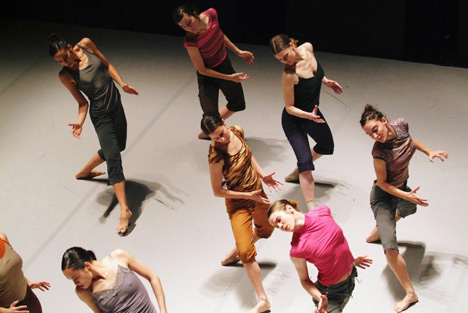
On the technical side, the lighting by Avi Yona Bueno was bright and airy, complementing the white dance floor and grey block-like set frame while providing an additional “realness” to the dancers’ every movement. Bueno created lovely shadows while playing up the stark contrast between the dancers and their large space. Costumes by Rakefet Levy, though, left something to be desired. The J. Crew, tank top, polo shirt, Capri, cargo short look is fine, but not if the dancers look like they just grabbed whatever was lying on the floor that day (really, a hot pink short-sleeved turtleneck, several different muted-color tank tops, and an orange polo shirt a costume design does not make).

“Three” will most likely not get the editing or make-over it needs to transform from a body of ideas to a statement of art, but hopefully when the company next returns, it’ll provide a little more thunder and lightening to accompany the R-E-S-P-E-C-T it likely deserves.


Photo by Batsheva Dance Company

Monday, September 25, 2006

David Dorfman Dance, YBCA, 9/23/2006

Politically Charged underground Plants Roots
David Dorfman Dance's underground
Presented by Yerba Buena Center for the Arts
September 23, 2006


Yerba Buena Center for the Arts kicked off its new Worlds Apart series with the Bay Area premiere of David Dorfman Dance’s underground. Using the 1960s Chicago activists the Weathermen as an impetus, underground, at a tight 50-minutes, provides an introspective look at the fine line between protest and terrorism, the feeling of apathy, and how each of us makes a difference today and in the future.

While Dorfman is a master of dance, he’s also a leader of incorporating movement and ideas into complex performance works, and underground is no different. Combining dance, song, text, and video documentary, Dorfman has created a thought-provoking work. His use of organizing bodies on stage may seem chaotic, but purposeful as well. Dorfman often placed his dancers into clusters or lines, perhaps in representation of groups of protesters versus army units lining up for battle. Dancers marched in circles, reminding us of the continuous need for action, and they often did this in pairs, riding home the idea that if we support each other, we may be more successful. This idea crept up again from time to time, from leaning on someone to pushing or encouraging them to stand up for their beliefs. Circles carried over into the more choreographed movement, with dancers performing hip swivels, spinning lifts, and spins with a sense of freedom and abandon.

Text and imagery played an important part in the “wholeness” of this work. At one point, Karl Rogers asked questions of the artists, and depending on their responses, they danced forward or back, somewhat like an icebreaker you might play at college orientation. Throughout underground, the use of a raised arm, a hand, took on profound significance as both a form of participation and a request to stop, and dancers spoke the word “now” in a whisper and a shout, emphasizing that our decisions at this exact moment affect everyone else to some degree. Jonathan Bepler’s score proved varied and moving, similar to a heartbeat at times and others like a lullaby rocking a baby to sleep.

One additional feature of underground was the use of local dancers as the corps. The dancers seemed competent and well rehearsed, and they blended nicely with the company’s performers.

The title underground seems to fit the work perfectly, and not just because of Sean Green’s Academy Award-nominated documentary The Weatherman Underground. Underground represents where we plant our roots and how we gain the nutrients to grow and survive. Can we grow if we stay silent? And if we have no roots, no convictions, no feelings or beliefs, do we then default to apathetic indifference?

The company’s post-performance discussion was particularly enlightening and many audience members from the full house stayed. Of particular note was how to move underground forward and have it seen by more audiences, and how to gain corporate support for such a controversial work (interestingly, David Dorfman’s presentation at YBC was sponsored by United Airlines).

David Dorfman Dance will next perform underground October 28th, 2006 at Connecticut College’s Palmer Auditorium.

Photo by Gary Noel
Dancer: Joseph Poulson

Tuesday, September 19, 2006

here comes the scribe

assignments were handed out the other day, and i've got a nice mix of modern and ballet. see "upcoming reviews" to the left for more details.

Thursday, August 03, 2006

mentally checking out

pointe shoes, slippers, and bare feet is on hiatus through the summer! until it returns, feel free to visit my other two blogs, which are full of un-witty banter and good cheer:)

shake ur groove thang
the bullpen baker

Wednesday, April 26, 2006

SF Ballet's "Sylvia," 4/22/2006

A Slight Error in Eros
San Francisco Ballet’s
Sylvia
Saturday, April 22, 2006, 8PM


Last year when I heard that Mark Morris’ Sylvia wouldn’t be presented during San Francisco Ballet’s 2004-2005 Season, I was bummed. Was it the orgy in the woods, the confusion of nymphs with potential nymphos, or the drunken topless slaves that did Sylvia” in? After 30 seconds of debate, I came up empty and moved on with life as I knew it. But luckily a year later, SF Ballet decided to bring the shirtless minions and story of female empowerment back to the stage.

I enjoyed Sylvia the first time I saw it. With Megan Low as a charismatic and youthful Sylvia, she easily convinced everyone to root for her, and had we been at a baseball game, there would have been foot stomping, drum beats, and the wave. Morris’ version spotlighted the story; it served as the primary focus, with the choreography more about imagery and ideas as opposed to superfluous sautés and promenades. (The choreography itself seems much debated, with several saying that Morris’ ballet knowledge is flimsy at best, but I disagree. Maybe they haven’t seen A Garden, Sandpaper Ballet, or Later, but trust me, Morris knows ballet, and it seems in Sylvia he decided to take a more organic, au natural approach to the majority of the movement vocabulary.) In short, your heroine needs to be believable in addition to a superb technician, and that is where this past Saturday night’s production failed.


Yuan Yuan Tan is no doubt an amazing dancer, with steady balance, a lofty presence, and extensions that reach beyond the pillars. Way back when, in Lar Lubovitch‘s (also modern-based and highly debated) Othello, she played the naïve card, with batting eyelashes and a big grin, and it worked, but this persona hasn’t been seen since. More recently she’s been known for her cool demeanor on stage, and not her girly, likeable personality. It’s tough to want Sylvia to find love when she literally looks like she wants to kill Aminta, who was played boyishly yet fully by Gonzalo Garcia. Now here’s someone whose performance quality speaks leaps and bounds -- he can perform technical feats with unabashed maturity yet exhibit the look and feel of a young boy in love with just a simple développé.

The supporting dancers proved willing and able, and while much of the movement is more modern based, there are still lovely attitude turns, arabesques, and piqués that remind us this is a top-notch ballet company. Jaime Garcia Castilla, as a last-minute substitution, served as our golden boy Eros. While not as warm as James Sofranko, he appeared ethereal and a good match to the goddess in silver, Muriel Maffre’s omnipotent Diana. (And did you know that Eros and Diana have the same tailor?) Brooke Taylor Moore, whose technique continues to evoke crispness, performed admirably as Sylvia’s friend, and several corps/soloist members stood out as ones to watch, namely Lily Rogers, Courtney Elizabeth, and Nutnaree Pipit-Suksun. Yuri Possokov, whose dancing career is on its last legs with retirement in sight, played the sketchy yet lonely Orion, and I couldn’t tell which he was grasping for more: his performing career or Sylvia. Martin West led the ballet's orchestra in a rousing and lustuous performance of Léo Delibes' score.

Syliva, while very true to the original story, varies from the traditional ballet in many ways, but as always, the success lies in all the pieces coming together, including the featured dancers. It’s not just about the dance, but also the theater, the dramatics, and the emotion, all combined into one big event that you hope will leave you elated but could just leave you hanging. The big picture is there, though, along with hope that other casts will succeed where this once didn’t quite gel.

Photo ©SF Ballet

Saturday, April 08, 2006

Doug Varone and Dancers @ YBCA, 4/7/2006

Varone and Company Rise to the Occasion
Doug Varone and Dancers
April 7, 2006 8PM
Yerba Buena Center for the Arts

15 years in the making, and Doug Varone and Dancers have returned to San Francisco. I wasn’t here the first time, as I was in middle school and probably off at a slumber party order pizza and talking about first kisses. But last night’s performance inspired me to hopefully catch the company again before another 15 years goes by. Presented at Yerba Buena Center for the Arts by San Francisco Performances, the company of nine dancers (including Varone himself) swept in for the first night of a three-performance run featuring three West Coast premieres, all focusing somewhat steadily on relationships and couplings.

The big hit of the night proved to be Varone’s Castles. With Prokofiev’s hauntingly eerie Waltz Suite, eight dancers paired up and flew around the stage with each other in a powerful dance of match, mismatch, and rematch. I had fleeting memories of the ballroom scene in Cinderella, processional and all, with each dancer searching for his or her special someone. The duet between Eddie Taketa and Natalie Desch proved particularly moving with emphasis on the pause, the thought, before each one advanced upon the other. And not only was their reflection and care evident with each place of a hand or the curve of the back, but Varone’s choreography proved thoughtful in itself. There’s no superfluous moves, no unnecessary gestures, no extra bold lighting cues. Instead, the dancers, the dance, and the costumes and set design-- it all comes together into a statement of hope and continuation, fully seen at the end with a flurry dancing spotlighted by the warm and touching lighting design by Jane Cox and Joshua Epstein.

Varone’s Rise, choreographed in 1993 and commonly referred to as the company's signature work, opened the program. Set to John Adams’ minimalist yet moving Fearful Symmetries, the work spotlighted four distinct couples dressed in violet, purple, teal green, and red. Emphasizing freedom of movement and solid release technique, the dancers overlapped in a smart study on the flow of motion. From mile-high leaps to steady balances in arabesque and supported lifts overhead, these dancers didn’t stop; even in a “resting state,” there’s plenty of emotion and dedication in their faces, presence, and line. Time doesn’t pause, and neither does the dance, with the pace charging onward and upward with fierce determination.

The Thing of the World showed us that Varone isn’t just about large group pieces that make you lean on the edge of your seat for 28 minutes. A duet for Varone and John Beasant III, The Thing of the World focused on what happens to a relationship when things go wrong. Stressing repetition in slightly different situations, we saw that not only do things not always happen according to plan, but that many times our emotions and actions get out of control, to the point of disastrous results. While including more gesturing and posturing than full on dance phrases and not as visually stimulating as Rise or Castles, The Thing of the World is an interesting study in its own right.

Doug Varone and Dancers marries contemplative, intricate choreography with talented dancers in what might be one of the most successful modern dance performances I‘ve seen for awhile. Yet Friday’s house looked only half-full at best, so let’s hope others catch on as well. While New York City is lucky to be home to Doug Varone and Dancers, San Francisco has received a gift with these three performances, and let’s hope that they return again soon.


Photo by Phil Knott

Friday, March 10, 2006

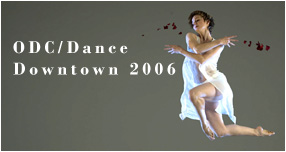
ODC @YBC, Program 1, 3/4/2006


ODC,(Not) As Easy as 1-2-3


ODC: Program 1
Yerba Buena Center for the Arts

March 4, 2006

It’s March, which could only mean one thing. No, not preseason baseball. Or the Oscars. Or my grandmother’s birthday. No, it’s the return of ODC to Yerba Buena Theater with it’s annual Dancing Downtown series. This year marks the company’s 35th, and to help celebrate, Joanna Berman, former principal dancer with San Francisco Ballet, will be performing in Brenda Way’s “Part of a Longer Story,” scheduled on Program 1 of this three-program series.

The Forum looked full Saturday night, and the crowd definitely contained a heightened energy. Prior to curtain, there were giggles, hugs, and chats (not to be confused with the conversations among a chatty foursome behind me throughout the evening), and it sounded like most people, rightly so, were most excited to see Berman “back in action.” Thankfully (and undoubtedly), Berman delivered, helping to elevate the evening from ordinary to something special.

“Part of a Longer Story,” divided into 3 parts, is set to Mozart’s Clarinet Concerto in D. Way choreographed the Second Movement (1993) prior to the First (1995) and Third Movements (2002), but this isn’t why it stood out among the other sections Saturday night. Berman’s technically and emotionally driven performance with Private Freeman elevated the movement from basic ballet-based positions to connected thoughts that portrayed the romance and elegance of modern dance. And no, I didn’t mean for this to rhyme. Berman’s attitude turn wasn’t just an attitude turn, but she gave it feeling and purpose. As she moved, each position appeared to connect to the next, with transcending liquidity and lacking time yet enveloping space, sort of like when you pour honey out of a jar. Berman expressed herself through her body as opposed to with it, and this is what made watching her so special.

The rest of “Part of a Longer Story” just didn’t compare. Perhaps it’s unfair to compare the company dancers, who are mainly younger and have less stage experience, to Berman’s more mature and complete performance. Yet I think Berman elevated Way’s choreography in a way that only she could: with an exceptional performance.

Way also debuted “time remaining” with music by Ara Anderson, and Iron and the Albatross. “time remaining” supposedly focused on the exploration of the “loss of individual will, manipulation and the lure of righteousness.” Had I not read that in the brochure, I would never have guessed. I really thought this was “Project Runway” meets modern dance. Not until the last few minutes, when dancers changed into potato-type sacks, did I even begin to realize “time” wasn’t solely about fashion; yet everything preceding screamed “fashion”: dancers in linen-like white clothing, partnering sequences with dressforms, a designer and his muse (which perhaps wasn’t a muse after all), and clothes falling off to reveal a canvas (or in this case, those canvas-like sacks). Way tackled an interesting subject, but I’m not sure if her construction provided the appropriate canvas needed.

K.T. Nelson’s “Lost at Sea” returned this year, and while I enjoyed it, I felt last year’s performance has more sparkle and overall continuity. There’s a constant struggle between moving ahead or in some other direction or tangent, and Nelson’s partnering and group work succeeds in transporting her movement from thoughts to solid, conceptual ideas. Also, newcomer Apprentice Elizabeth Farotte performed with clean attack and languid lines and is a wonderful addition to the company. In fact, during one of her first entrances, for a few seconds, I thought she was Joanna Berman. Now how’s that for a compliment?

ODC continues with Program 2 (I'll be there on the 10th), and I'm hopeful that things will look up. Perhaps my expectations are high, but in comparison to last year, I feel that the dancers aren't as strong technically and the choreography a little too predictable. Here's hoping this anniversary season rises to the challenge of more than just matching Berman's prowess on the stage.

Saturday, February 11, 2006

KUNST-STOFF at YBCA, 2/10/2006

Sight Slightly Unseen

KUNST-STOFF
Presented by Yerba Buena Center for the Arts
February 10, 2006, 8PM

Photo by Andy Mogg


Yannis Adoniou’s KUNST-STOFF, a local dance-theater company, is known for their risk-taking and originality. But with all risk-taking, sometimes you get a bang and others a bust, and the ensemble’s two-day run at Yerba Buena kicked off last night with only a slight rumble.

The program opened with the world premiere of Adoniou‘s rough-around-the-edges “as we close their eyes” which was created through a partnership with The Lighthouse for the Blind and Visually Impaired. Examining the essence of “seeing,” the performers explored the perception of movement through sound, breath, touch, and text. One of the most poignant sections occurred during a duet for Kara Davis and Jose Campos. With impeccable timing, they supported and complemented each other through a series of various turns, lifts, and gestures. On stage, Sheldon B. Smith and Leslie Schickel accompanied them vocally, each providing their own verbal interpretation of what they saw. One might say “arabesque” while the other describes the moment as “lifts her leg,” proof that words, no matter how accurate, never quite paint a full and vivid picture, but that they also define what you do or not perceive to be happening. Other parts, such as the live camera work and sound-producing wire, though, cried out for more foresight and fleshing out, and the work overall felt underdeveloped.

More successful, however, was Adoniou’s “In-Sight,” which premiered in 2004. Displaying striking photography by Cara Judea Alhadeff, Adoniou continues to explore perspective, but this time through a more abstract manner than “as we close their eyes.” Again, what struck me was Adoniou’s intuitiveness into partnering. Here his creative juices, along with Jethrow DeHart’s pulsating sound score, flowed and excelled, and Adoniou pulled out little threads of rhythm and inspiration that he only hinted at in his group and solo choreography: more than his modern play on classic yet contorted ballet positions, greater and intricate positions, complex timing, a unexpected placement of a hand on the leg. The partnering displayed an attack of the actual movement, the in-betweens that we sometimes miss, the perspective of the dance. It’s this that propels “In-Sight” forward from concept to execution and above and beyond “as we close their eyes.”

Yannis Adoniou is on the right track. His ideas have merit, and he can obviously choreograph like no tomorrow. With more development, “as we close their eyes” could greatly succeed in helping to promote and expand our understanding of our senses and their ability to enhance our state of being, and these two works together would be a boom of an evening.

Wednesday, January 11, 2006

The Kirov Ballet's 'The Sleeping Beauty' at CalPerf, 10/2005

Potential sleeper depends on Aurora to keep us wide awake
The Kirov Ballet at Zellerbach Hall
Presented by CalPerformances
October 12, 2005

The Kirov Ballet returned to Berkeley last night with Konstantin Sergeyev’s “The Sleeping Beauty.” Based on Petipa’s choreography and including “fragments” by Fedor Lopukhov, the October 12th performance served as a Diana Vishneva tour de force. Her Aurora proved to be the highlight of the night, and made me glad I traveled via MUNI and BART to see her come of age, draw blood, slumber, and after much beauty rest, find love with a man who wears golden slippers and, thanks to some technical help, hits a bulls-eye on the first attempt.

Vishneva’s interpretation added magic to the air, and while this is normally a fairy’s job, no one could outshine her. She convincingly transformed from 16-year-old ecstatic teen to confused spindle pricker and then wise, love-stricken bride. All eyes followed Vishneva from step to step, and while the corps de ballet’s missteps were minor, they greatly lacked the oomph and zest which Vishneva provided. Uliana Lopatkina’s Lilac Fairy served as a nice balance to Vishneva’s dynamic Aurora. Appropriately bathed in a bright lavender spotlight throughout, Lopatkina displayed steel will and languid limbs, and this Lilac Fairy differed from the sprightly fairies of days gone by; her mature portrayal displayed an urge to provide protection and guidance, a mystical mother figure if you will. Trust me, don’t mess with her or she’ll arabesque you! Carabosse, played rather creepily by Igor Petrov, discovered this on several occasions.

One of Vishneva’s most glorious moments came in Act I where she piquéd into attitude and then relevéd into attitude entournant, adding a side cambré and making the entire movement seem circular and all-encompassing. She continued this sweeping image through each step, and her développés, passés, and pirouettes seemed never ending. This magnified when, dancing with her Prince Desiré (Igor Zelensky), she was on pointe in a low penché with the same spiral-like side cambré, and Zelensky held onto her hip softly while pulling away and promenading her, emphasizing the curve of the movement while displaying trust between the two dancers. Zelensky’s Price combined nobility with humbleness. His dancing, while crisp, contained a natural elegance that shone through constantly, such as in a set of chaîné grand jetés in a large circle, but came to fruition in his partnering sequences. Dancing with Vishneva, he held her softly yet steadily, and they made a spectacular pair onstage.

Other dancers stood out, particularly Yana Selina’s effervescent Lightheartedness Fairy and flirty Puss (the cat), Viktoria Tereshkina's polished Diamond Fairy, and Yana Serebriakova’s shining Sapphire Fairy and poised Courage Fairy. Anton Korsakov’s Blue Bird fluttered about with strong brisés and lovely pointed toes, but his Princess Florina (Yulia Bolshakova) had issues taking flight. The sets added a needed ambiance and featured a sprawling golden gate (not the kind we have in San Francisco), a springtime garden full of greenery, and a sepia-toned forest. In addition, the Orchestra overcame a sloppy Prologue and played well for the remainder of the evening

Vishneva’s Aurora conveyed beauty in an infinite amount ways, but it couldn’t conceal some of the major imperfections. The Kirov brought the older “Beauty,” as their new version doesn’t fit on U.S. stages, yet this one still looked cramped (perhaps due to the multitude of well-coached students on loan from San Francisco Ballet School) on the Zellerbach stage, and at three hours and 40 minutes, this “Beauty” treads on overstaying its welcome. Overall, the dancers looked tired and lacked energy, and it was the three leads, particularly Vishneva’s divine interpretation, that kept me awake and wanting more.

Compagnie Jant-Bi 'Fagaala,' YBC, 10/2005

Compagnie Jant-Bi 'Fagaala'

Reflecting on the past and looking towards the future
October 7 , 2005
Yerba Buena Center for the Arts, San Francisco

Germaine Acogny’s Compagnie Jant-Bi landed with a bang in San Francisco Friday night. Acogny, choreographer and “mother of contemporary African dance,” along with Japanese choreographer and Butoh-trained Kota Yamazaki, weaves a multidimensional and thought-provoking combination of dance, music, and theater into an inspirational evening-length work for seven male dancers entitled “Fagaala.” Currently touring the US and Australia, “Fagaala,” which means genocide in Wolof, the Senegalese language, claims inspiration from the genocide in Rwanda but doesn’t seem to judge or criticize past events. Instead, it takes us on a journey of the human experience during this violent period.

While I initially balked at combining contemporary modern movements, African dance, and Butoh-inspired dance into one seamless movement vocabulary, Acogny and Yamazaki succeeded in their effort, presenting a contemplative array of ideas in a loose yet directional framework. Jant-Bi’s seven dancers, Babacar Ba, Cire Beye, Abdoulaye Kane, Pape Ibrahima Ndiaye (Kaolack), Ousmane Bane Ndiaye, Tchebe Saky, and Abib Sow, performed admirably, with crisp technique and a passion for performance. They displayed a power onstage that is rarely seen. There’s a moment early on, when the cool lighting changes to a warm, golden hue, and the dancers stare into the audience with a look of longing and reflection, but when the mood shifts back to blues and grays, their faces reveal the cold, harsh reality of life as a conglomerate of solitary moments fused together. The dancers’ physicality extended beyond the forearm cartwheels and back headstand walkovers to capoeira-style kicks, modern lifts, hip rolls, and curvatures of the back. Throughout, they emphasized the physical body as a representation of the individual and the masses and visions of masturbation, sexual conquests, murder, and birth populate the work. Genocide tore apart these bodies, these people, in a raw and vulnerable way, and it further affected how they viewed themselves and everyone else around them.

One of the final segments brings many of these ideas together in a unique way. The dancer who earlier with his shirt covering his face gyrated his pelvis back and forth for four minutes in a spotlight of pale yellow light, returned to the stage covered in chalk-like dust, resembling a statue or the body of the deceased. Downstage, he moved at varying speeds, jumping, swaying, and gesturing, and as he did so, dust would lift off of his body and extend into the audience, the wings, and the stage, emphasizing that we are all connected, and while this travesty occurred in the past, it is not forgotten. We have a common responsibility to correct the errors of the past and create a better, more accepting world instead of one where genocide is condoned.

Not everything, though, works in “Fagaala.” For example, long drapes of fabric are overused in contrived manners, such as running from wing to wing being held above the head or draped over a dancer suggesting ominous things to come. But this is trivial compared to the rest of the work which exceeded my expectations and had the gears in my head spinning from the end of the performance through now. “Fagaala” truly presents compelling and provocative images in a multi-faceted, rousing, and exciting performance, and I hope it inspires and affects others for years to come.

West Wave Dance Festival, Program 9, 7/2005

Wild (yet) Mild West
West Wave Dance Festival
Program 9 at ODC Theater
July 30, 2005

A few weeks ago, I saw Program 2 of the West Wave Dance Festival, and while sparsely attended, the majority of the choreography infused originality with maturity. Last night at the opening of the two-day run of Program 9, the audience filled all of the seats and more. Perhaps this was a preview of things to come, as the works presented were not nearly as fulfilling as those of Program 2.

Two pieces stood out above the rest. With energetic and poignant music performed live by Sekou Alaje and Garno Da Paz (composed by Alaje and Ajai Jackson) and powerful vocals by Rhonda Benin, Kendra Kimbrough Barnes’ excerpt of Enduring Legacy, based on the death of her mother, combined traditional African dance with modern movement into an abstract retelling of a memory of her mother. Barnes’ choreography never stopped flowing, and her dancers’ (Shelley Davis, Clairemonica Dixon, Kelly Kennard, Latanya Tigner, and Barnes) ability to move from one genre of dance to another was quite impressive.

EmSpace’s Erin Mei-Ling Stuart presented an excerpt of How to See Red, a work that focuses on consciousness and the attempt to contemplate and understand what goes on inside of our heads. With costumes by Leigh Anne Martin that resembled an Anthropologie catalog, Stuart’s dancers, from a raised arm to sitting Indian-style, exuded a physical and emotional professionalism not seen anywhere else during the evening. Inventiveness, structure, and developed phrases tend to be Stuart’s strengths, and How to See Red proved to be a great example of this. While the overall work is still unfinished, I can’t wait to see the final product, which premieres later this October at Dance Mission.

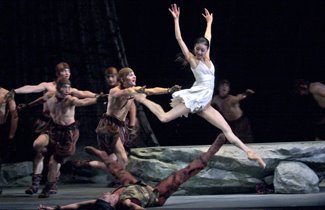
Heidi Schweiker, a dancer in both Margaret Jenkins’ and Janice Garrett’s dance companies, presented the premiere of Come Rain, a solo for herself accompanied by an original score by local music extraordinaire Daniel Berkman. Her directional choices peaked my interest; she progressed from sharp and jagged to soft, sensual, and reflective, and her movements were focused, deliberate, and thoughtful. But Come Rain appeared more as a movement study than as a choreographic work. The debate between these two is for another day, however. Nancy Karp’s Trio Set, performed by Christy Funsch, Diane McKallip, and Anne-Lise Reusswig, felt like a placeholder. Based to some degree on the play Three Tall Women and with minimalist movement reminiscent of the early 80s, Trio Set focuses on graceful dancing that builds up and then POW, changes direction or focus. While some aspects are successful, I felt that the dancers never quite related to each other; instead, there were three separate entities dancing onstage instead of a trio. The first work of the evening was by Moving Art’s Michael Lowe with the premiere of Ghost, Life Unfinished, a fictional work that is abstractly based on the life and death of Teresa Teng, a popular Chinese folk singer. Lowe attempted to fuse traditional ballet with Chinese folk dance, but the outcome appeared superficial and unclear. Much of Lowe’s focus was on actual classical ballet positions and flexed wrists and not on the movements in between, and I felt uncomfortable watching the work, as though I were looking at pictures of Caucasian women dressed up as an American’s traditional image of a Chinese woman (black bob wig, white face, white cheongsam) with the addition of pointe shoes. Lowe has received a lot of praise for his choreographic skills, so I hope this work is simply a fluke of nature.

Overall, Program 9 presented some worthy choreography, but I feel that the expansion of the festival has caused some of the quality to be watered down. In both programs that I viewed, there was one piece of choreography that was clearly not up to the level of the others. Perhaps the festival needs to revamp how works are selected, who presents on the emerging choreographers’ program, and who presents at all. Even with the below-average selections, I believe that the festival as a whole offers Bay Area choreographers a supportive and intimate forum to present their work. Let's hope the festival is a little more focused next year.

Bolshoi Ballet's 'Romeo and Juliet' at CalPerf, 11/2004

Marriage of Old and New Lacks Innovation and Cohesion
November 5, 2004, 8PM
Zellerbach Hall
Presented by Cal Performances

Lar Lubovitch’s “Othello” and Mark Morris’ “Syliva” are two examples of contemporary retellings of stories from days gone by. They combine ballet, modern, and folk movements to create a new version of what we thought we knew. While potentially controversial and not for all tastes, they have succeeded in a new telling of the old. I had similar hopes for the Bolshoi Ballet’s “new” take on “Romeo and Juliet.” While I knew that the work didn’t include tutus or pointe shoes, I hoped that something new would present itself.

Directed by British theater director Declan Donnellan and choreographed by Moldavian Radu Poklitaru, the Bolshoi’s modern “Romeo and Juliet” echoes of “West Side Story” (The opening scene made me want to snap my fingers and sing “When you're a Jet…”) meets movement theatre. With a minimalist storyline, we meet Romeo, Juliet, a cross-dressing Mercutio, and an incestuous Lady Capulet (with Tybald, no less). The basic plot, though pared down to the necessities, stayed the same: Boy meets girl. Boy and girl fall in love on the spot. Family pouts and stomps. Etc. etc. etc.

Simply put, this “Romeo and Juliet” is no ballet. Probably the most disappointing aspect of “Romeo and Juliet” is the fact that dance itself (whether it’s ballet or modern) failed to make an appearance. Sure, there’s movement, but it is pedestrian and is continuously repeated to the point of becoming ineffective. The ballet steps are fleeting, and seem inconsistent with the more ordinary and quirky movements, often in unison, that fill the rest of the work. The lone arabesques, pirouette variances, and sautés that are utilized are interspersed in between posing, rash arm movements, and unsupported choreographic choices; this causes a lack of momentum throughout the piece. While corps dancer Anastasia Meskova as the naïve Juliet seemed the most at ease, the entire company had trouble delivering the Broadway dance-type sequences, Britney Spears pelvic gyrations, and flexed-feet requirements. What a shame, because they’re obviously trying! The corps is used well, at time representing townsfolk, the two warring families, and the supportive foundation of a budding relationship, but perhaps a more experienced choreographer would have developed the movement vocabulary to a higher degree. Instead, it appeared elementary and muddy. This confusion also transcended to the costuming, which ranged from top hats and tails to Company B-type outfits and “Stepford Wives” dresses; the lack of consistency again detracted from the overall performance. Maybe minimalist costuming, like the interesting and underused cubic and rectangular set design, would have helped.The Bolshoi Orchestra, though, performed Prokofiev’s score admirably with ease and energy.

The Bolshoi’s “Romeo and Juliet” feels more like a theatre piece. The static direction and lack of choreographic imagination hinder the work’s development, and it’s one that doesn’t break new ground or present an original view of the traditional storyline. From gyrations and posing to random breakdancing moves, the choreography lacks a maturity that we have come to expect from one of the top international dance companies. While the full house at Zellerbach seemed to enjoy the work, I feel that Donnellan and Poklitaru’s version did little to enhance the storyline or dance prowess normally associated with this ever-traditional ballet.